Showing posts with label Blog Book Tour. Show all posts

Wednesday, October 26, 2011

Blog Hops, Book Tours and Book Reviews, Part Deux


You know how a picture's worth a thousand words? It occurred to me that maybe a link or two, directing you to a blog hop or a book blog tour or a book review, might be a good way to show you how everything works. So let's follow Cathy-on-a-Stick up those ooky cave stairs to...

THE COFFIN HOP HORROR WEB TOUR!!!

Here we have a themed blog hop, where a bunch of horror writers (97, to be exact) are waiting for you to drop in this week and get the bejeebers scared out of you. (There are some scary writers out there, my friends, writers who make you pray that you will NOT run into them on a dark and creepy night. Alone. In the woods. With their laptops in tow.)


Anyway, notice how each writer gets a chance to promote his/her books or stories or poetry, and you get a chance to perhaps find a new favorite writer--and win a prize or two while you're at it. Bet you'll also notice that some writers have done a great marketing job, from getting followers, to promoting their work, to offering fun contests. (You'll want to be one of those writers if you participate in a blog hop.)


Okay, now we'll hop into our time machine so we can visit the WOW!BLOG TOUR with Linda Hubelek's book, Trail of Thread, here at the Hall of Fame back in May of this year.


You'll notice that I talked a little about Linda and gave a short synopsis of her book. Often, authors will prepare ten to twelve posts on different topics and blog hosts can choose a topic. So I asked Linda to share a little about writing for our descendants. And I ended the blog book tour with a giveaway of her e-book, which Linda provided. Now here's a little something from behind the scene. Though I didn't get a ton of visitors commenting that day for a chance to win Linda's book, I did get a ton of visitors to the blog. And I still get hits on that post. So as a host, I attracted readers who might not have come to the Hall of Fame (and some of them signed on as followers and return). For the author, the promotion stays out there forever, possibly drawing new readers every day.


Finally, let's sneak a peek at some of my favorite spots to catch a BOOK REVIEW!


Sometimes, I'll review a book just because I like the book. My friend (and a swell writer herself), Sally Apokedak, often reviews Young Adult and Middle Grade novels just because she wants to. If I want an in-depth and thoughtful discussion of a book, I'll read Sally's reviews. But don't expect her to give away her books. (She might let you borrow one or two, if you know her.)


Any time you drop into Jodi Webb's blog, you're likely to find a book review. She reviews just about everything, from adult to kidlit. I like how Jodi gives a short synopsis, then follows it with her review, and then gives her readers a chance to win the book. Jodi is usually provided books by publishers; if you review a few books at your blog, don't be surprised if you're contacted by publishers, asking you to review their books. I rarely review books when contacted by a publisher, but I will do so if a. I LOVE the author and have already read other books by him/her or b. I REALLY, really love the author (in a writing kind of way).


So, I hope those links painted a better picture than all my blah-blah-blahing about blog hops and blog book tours and book reviews. Honestly, I'm wore out. (And Cathy-on-a-Stick's getting a tad peckish, too.)

Tuesday, October 25, 2011

Blog Book Tour, Book Review, Blog Hop: What's the Dif?

So, you see that your author friend is doing a blog book tour and you wonder what the heck is that? Or you see that another writer friend is doing a blog hop and you figure that must be the same thing. And then you decide that really, they're both just a way to get a book reviewed. Why make it all so confusing?

Because it kind of is confusing. Your friend's book may be making the rounds on a blog book tour, but may not be reviewed at every blog. And a blog hop can include a book review, or giveaways, or just a bit of promotion. Perhaps we need to take a closer look...

Blog Book Tour: When a book goes on a blog tour, the book's author usually submits a post of some sort to the blogger. Often, the post will be in an interview format, and sometimes, the author will make him or herself available for questions from blog readers. The post may also be a topic discussion related to the subject of the book or the author. Say, for example, a fiction book about the Salem witches is on tour. You might read about "How To Research for Historical Fiction" or "How I Got My Book Contract." In a blog book tour, you'll find a summary of the book and oftentimes, you'll find a book giveaway at each stop. And sometimes, you might find a short book review, mostly in the form of a recommendation. So, if you're interested in a newly released book, search the author's website for a Blog Book Tour. Somewhere along the 20 stops or so, you'll win that book. And if you have a book coming out, contact blogger friends and schedule a blog book tour. Or use professionals (you'll pay a fee) to help you target blogs with the right readership for your book.

Blog Hop: A blog hop is a fun way to get a ton of blogs involved in a common purpose; it is NOT a book tour. It is, however, a great way to get promotion if you have a book. Blog hops are usually centered around a theme...scary reads, foodie books, romance. All the participating blogs plan a post and usually some kind of giveaway (a great opportunity to talk about your book!). Honestly, it's the prizes that draw readers to a blog hop. And here is where promotion for a book comes in. An author may offer a free download of the first chapter of his or her book to every commenter, or will sponsor a contest giveaway for the book. And don't forget that getting folks to the blog is the first step in getting them to return! So a blog hop is also about encouraging readers to join as a follower, or sign up for Twitter or Facebook. The key word in a blog hop is fun, so if you're thinking of participating, think outside the box. And keep in mind that blog hops usually last for a set period...say a week. Have your post prepared to go from the first day, and keep it up all week. You don't know when readers will be hopping to your blog!

Book Review: A book review is pretty cut and dried. A publisher sends a book to a blogger and the blogger gives a review. Often, the blogger will give the book away. Some bloggers know how to write reviews, and others not so much. If there's a genre you love (and write!), there's likely a ton of bloggers who review it. Find a blogger you respect and you can keep up with what's being written in your genre. But as an author, you need to know that a blogger's book review may or may not be favorable. Often, it's the publishers (or their representatives) who contact bloggers to do a book review (rather than the authors).

Now, that's about it. Or maybe not. No, that's it. Um...let's just close the book on the subject for now, okay?

Monday, May 23, 2011

Monday Morning Winning


First, I'd like to thank everyone who dropped by for Linda Hubalek's blog book tour, Trail of Thread. What an intrepid group of journalers you are!


I've never had much success with journaling...my journals start with a bang (of super awesome events) and end with a whimper (of what we had for dinner that night). But perhaps, I shall take up pen once again. Some future Hall may be fascinated by my description of hot dogs topped with cole slaw and onions.


Oh! I forgot to name the winner of the ebook! It's Sally Apokedak! Which seems only fitting since she's a mad journaler herself!


(Um, I mean super awesome journaler, Sally. Not crazy as a bedbug/angsty angry journaler. You knew that, right?)


Wednesday, May 18, 2011

On the WOW!Blog Tour with Linda Hubalek and Trail of Thread


A few years ago, I watched a program where modern families lived as pioneers on the prairie--and I was fascinated, entranced, and absolutely riveted. So I jumped at the chance to host pioneer writer, Linda Hubalek and her book, Trail of Thread.

Linda has always loved the prairie--she graduated with an Agriculture/Horticulture degree from Kansas State University--but never so much as when she moved away from her beloved Kansas. She started writing then, about her home and the pioneer women who tilled the soil. She's since moved back to Kansas, where she keeps bison(!)and once again farms.


Trail of Thread is her first book in a series, told in letter form, from the women who not only survived but thrived out there on the prairie, women who were, in fact, Linda's ancestors, tilling the Kansas farmlands. I asked Linda to share with us her thoughts on writing for our descendants. Because maybe there's a riveting book in your family!

What will inspire my descendants?

My mother gave me a page-a-day diary for Christmas the year before I got married. She thought that I could record the planning of my August wedding in this little hard bound book.

I started on January 1st, my fiancĂ©’s birthday, telling of what we did for his special day. And I continued to write short bits of my daily life, besides the intended lists of preparations for our wedding.

Thirty-five years later I’m still writing in a page-a-day book. I sometimes get behind and don’t write for a week or two, but the majority of my life is recorded the 35 books that are stacked in a file cabinet.

The neat thing is I can go back to any given day in any of those years to see what I did, or what the weather was like. I can go back to remember a special person’s birth or death, and be drawn into the same feeling I had that exact day.

My family knows I’ve written down my life—and theirs— through the years. I haven’t written down anything that will embarrass anyone, but I think the entries will give the next generations a good glimpse of their ancestor’s lives, and the times we’ve lived in.

Will that inspire them to keep their own diaries? I really doubt it, although it would be great if someone was motivated to write and pass down more of the family history.

What I hope my diary entries would do is to inspire descendants to remember family members as I mention their birthdays, to learn the history of the family pieces they inherited, and to give them a sense of whom their family was— and did during their lifetimes. My Trail of Thread series, written in the form of letters to other family members, gives the reader a sense of the character’s lives and the history that was happening at that very moment.

Please read the books, and then think how you could pass on your life story to your descendants. How will you inspire them? It’s up to you….


Linda's giving away an ebook of Trail of Thread to one lucky commenter (and remember, you can download a FREE Kindle reader at Amazon if you don't have a Kindle!). Oh! And if you're a quilter, you'll love that Linda includes quilting patterns in each book, including Trail of Thread!

Find out more about this pioneer series at Linda's website. And she's on Facebook, too, so you can keep up with her and her books over there. Meanwhile, back at the ranch, I'll be reading Trail of Thread. (Comments will stay open through the weekend for your chance to win a copy!)

Wednesday, April 13, 2011

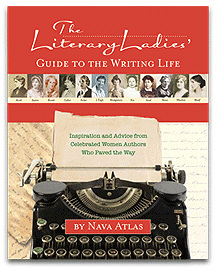
The Literary Ladies Guide to the Writing Life (Wheee!)


Ooooh! I’ve been excited about sharing The Literary Ladies from the moment I met them!

Technically, I’ve known the literary ladies from Nava Atlas’ wonderful book, The Literary Ladies Guide to the Writing Life, for many years. I met a few of them when I was just a gangly teenager with braces. Reading Jane Austen’s Pride and Prejudice made me feel quite elegant, and curling up with Charlotte Bronte’s Jane Eyre introduced me to gothic romance (so much more exciting than skinny, pimply boys falling off surfboards at the beach).

Still, I didn’t know the literary ladies like this, their writerly and not-so-writerly whys, and whats and hows of the women behind the books. Nava Atlas did her homework to bring us an inside look at The Literary Ladies, and I’m thrilled to be able to share some of her insights today at this, Nava’s last stop of her WOW! blog tour. So on to the questions!


With the perspectives of all these literary ladies, your book is unlike most guide-to-writing books, and yet it contains an abundance of advice and guidance! So which came first—choosing the literary ladies or finding all that brilliant writing wisdom?
It was definitely finding the wisdom first, then narrowing it down to the twelve authors. I was looking not only for wisdom, but for writings about the universal concerns and obstacles inherent in the writing life, viewed through the experiences of authors who eventually surmounted these difficulties.

It took several years of occasional delving into diaries, collections of letters, interviews, and memoirs to amass enough material for a full-length book. I’m quite a library geek so I loved having an excuse to bury myself in dusty volumes and archives.

As you researched, did you find women writers you hated to leave out? Who didn’t make the final cut, and why?
Above all, I hated to leave out Zora Neale Hurston (ca. 1891-1960). She was not only a literary pioneer with a distinctive voice (best known for Their Eyes Were Watching God), but studied anthropology in the 1920s at Barnard College, where she was the sole black student.

She seemed to be such an exuberant, courageous spirit, but her efforts were always undercut by money troubles. She died alone and forgotten, but then Alice Walker helped resurrect her legacy. Now her books have sold in droves and she is studied widely. However, I just couldn’t find enough about her writing life (other than her money woes pertaining to such) to weave through the chapters.

I almost used Marjorie Kinnan Rawlings (1896-1953), author of the children’s classic The Yearling, as she did leave a fair amount of writings on her life as a writer, but there was some indefinable thing about her that somehow didn’t resonate with me; she often seemed to have some axe to grind. Ultimately I thought that twelve was a better number than thirteen, and not just due to superstition!


So many interesting and surprising tidbits of these writers’ lives are included that I’d love to share all the secrets! But since my book efforts are in children’s literature, I’ll go with Louisa May Alcott, author of Little Women. Can you divulge a shocker or two about sweet Louisa?

Louisa May Alcott was a hard-working, strong woman. The biggest surprise for me was that she wrote lots of anonymous thrillers and gothics before her classic Little Women was published. She did them because she needed the money to support her mother and sisters. She thought of Little Women as just another job, cranking it out to make a quick buck. Both she and her publisher were surprised at its immediate success. One of the anonymous thrillers she wrote, A Long Fatal Love Chase, was republished just a few years ago with her real name. I read about 90% of it; sorry to say I didn’t think it was very good, and LMA may well have agreed with that assessment.

What I like about Alcott was her determination to earn a living from writing and not being wimpy about demanding her due. It took decades of slow but steady progress, but she did finally earn not just a living, but a tidy sum from Little Women and the books that followed. Unfortunately, she only lived to the age of 55, and was pretty well worn out by overwork and illness by then.

If you could sit down and have tea and a chat with any of these women, with whom would you choose to share an afternoon? (Goodness, reading this book has already improved my literary skills!)
I notice lately that some women with whom (see that?) I have been in touch have revived the word “whilst.” So maybe there is a trend toward better grammar and classic vocabulary!

It would be hard to choose, of course. I would have loved to meet them all and do the things they enjoyed doing—go to the opera with Willa Cather (though I found her to be a bit intimidating); stroll with Edith Wharton in Paris, visit with George Sand and all her famous literary and musical cohorts at her lovely estate in central France; and see how Edna Ferber went about transforming her novels into movies and Broadway shows.

I’ve been asked who I would like to meet if I could choose but one, and that would be Charlotte BrontĂ«. Her use of the English language was so exquisite that I imagine she’d be a good conversationalist. She also seemed so tough and determined in persevering not only on her own behalf, but that of her literary sisters, Emily and Anne. She sometimes invoked her small stature, and as another very petite woman I would enjoy looking her in the eye!

I’m sure it’s hard to pick a favorite piece of writerly (Oops! Maybe I’m not as improved as I thought.) advice or inspiration from these literary ladies, so I’ll just ask you to leave us with the quote that resonates with you today.
You know, the word “writerly” (and even “writery”) has come up several times in conversations about this book. My word processing program doesn’t highlight it as an error, so I think we can safely use it; it’s a great word!

Since you’re interested in children’s literature, I’ll leave you with a quote by Madeleine L’Engle (1818-2007), best known for the YA classic A Wrinkle in Time. As both a writer and visual artist, I remind myself that it’s important to take risks, even though it feels like I’m constantly trying to reinvent the wheel:

“Risk is essential. It’s scary. Every time I sit down and start the first page of a novel I am risking failure … We are encouraged only to do that which we can be successful in. But things are accomplished only by our risk of failure. Writers will never do anything beyond the first thing unless they risk growing.”

—From Madeleine L’Engle Herself, 2001


You. Will. Love. This. Book. If you’re lucky, you’ll win the copy I’ve pored over. Leave me a comment about your favorite literary lady, or if you have a question for Nava, she’ll be checking in today with answers. On Monday, I’ll draw a name.

If you’re not so lucky here, don’t despair. Nava has assured me that there are plenty of copies available of The Literary Ladies Guide to the Writing Life. So either way, make room on your shelf for this wonderful book. Seriously, you'll whee for excitement, too.

Um, you know what I mean.

(P.S. Just heard from Nava that she'll be making another WOW! blog stop, so we'll ask her to leave details in the comments. But that doesn't mean you can slack off here. A wheee in the hand is worth two wheee's in the future blog.)

Thursday, March 3, 2011

Letters From Home By Kristina McMorris


We have an expression around the South that dates back to when writing letters was commonplace. Let's say you tried a recipe that didn't go over too well. You might say, "It was nothing to write home about." Even back when we wrote letters, we acknowledged that taking the time to "write home" about something was special.

And today, I've got something special to share with my home readers. It's a lovely book called Letters from Home by Kristina McMorris who's on a WOW! Blog tour this month.

Kristina McMorris lives in the Pacific Northwest with her husband and two sons. She has garnered more than twenty national literary awards since writing her first novel, Letters from Home. A graduate of Pepperdine University, she spent twelve years hosting weekly television shows, including an Emmy® Award-winning television show at age nine. Prior to her literary career, she was the owner of a wedding/event planning business and public relations director of an international conglomerate.

Here's a brief synopsis of this charming story:

In the midst of World War II, a Midwestern infantryman falls deeply in love through a yearlong letter exchange, unaware that the girl he's writing to isn't the one replying. Woven around this tenuous thread are three female friends whose journeys toward independence take unexpected turns as a result of romance, tragedy, and deception, their repercussions heightened by an era of the unknown. "Ambitious and compelling...[a] sweeping debut" (Publishers Weekly), LETTERS FROM HOME is a story of hope and connection, of sacrifices made in love and war – and the chance encounters that change us forever.

I love the concept of this book, of the letters from home. And I worry that we'll lose the art of letter-writing what with technology zipping along faster than the U.S. Mail. I asked Kristina to share a few thoughts with us about letters, and the writing thereof. Here's what she had to say:

"Throughout history, forms of communication have evolved. Telegrams have become phone calls. Mailed documents have become faxes. Letters, even to express adoration, have generally become quick, convenient electronic messages.

For example, here's a possible note of endearment via email:

Hey, hon! At work, thinking about ya. ;)
The photo you sent was fab…might have to blow it up life-size, LOL.
I'll call later, k?
xo,
R.

In text messaging, an exchange between lovebirds might look like:

"Howz ur day?"
"Gr8. U?"
"Good."
"Luv u."
"Me 2."

And, on Facebook you could even luck out by getting "poked." (Although I'm still not entirely clear what that means.)

The benefit of speediness in today's correspondence is inarguable. But have we lost something meaningful in the process? No matter how heartwarming the message might be, how many times do you reread an email? Or a text? A tweet?

Until a few years ago, I had no idea my grandparents had met only twice during WWII before getting married. Upon revealing this astounding tidbit, my grandmother retrieved from her closet a secret collection of the wartime letters responsible for initially forging their bond.

In contrast to the modern-day exchanges above, here is an actual excerpt from one of my grandpa's letters:

"Every night I dream of you and those nights and days we have spent together. There shall never be another for me but you, Darling. Every part of me is true blue to the one I love…..Gee, Darling, how happy I would be to let you sleep on my arm tonight and every night from now on. I love you! Just 62 more days! Bushels and bushels of kisses, Hon.

Your loving husband,
Merle"

Indeed, that is the type of letter worthy of repeated readings. In fact, this was the very stack of letters that inspired me to write my first novel, LETTERS FROM HOME, thereby changing the course of my life.

So yes, life is busy, and time always seems in short supply. But every once in a while, take a few minutes to express how you much you care—through a device that doesn't have an on-button, that is. You never know how deeply your message might reach, or who else you could inspire even decades down the road."

That is so true, Kristina! In fact, I'm inspired right now. I'm giving away a copy of Letters From Home to one lucky commenter. I'd love to know about the last time you sat down to "write a letter home."

I think for me, it was the summer I spent in Europe. But I have a feeling I left out all the good stuff in that letter!

P.S. You know every letter has to have a P.S. Here's yours: For more about Kristina and her book, Letters from Home, check out her website at kristinamcmorris.com.

P.P.S. Oooh! Remember the P.P.S.? I forgot to tell you that the giveaway runs through Monday. I want to give all my readers plenty of time to write home to Cathy C's Hall of Fame for a chance to win!

Wednesday, February 9, 2011

When Did Writing Non-Fiction Get to be So Fun?


I am seriously thrilled to have Vicky Alvear Shecter visiting with us here today! And I’m even more thrilled that she’s still speaking to me. Because I asked her all sorts of questions about her latest book, Cleopatra Rules! The Amazing Life of the Original Teen Queen over at Finders & Keepers. Then I sorta badgered her to come over here and talk about writing non-fiction. And then I kinda suggested she give away something to help my writer friends.

Vicky’s a bit of a history buff. Which is like saying The Beatles were a bit of a band. But Vicky’s not your typical dry, history writer. Her brand of story telling is witty, contemporary, and very kid friendly.

So here’s my first question: Was it harder or easier for you to sell a history book with such an irreverent style?
Harder! Not everyone is comfortable with my approach although, surprisingly, the folks who seem to like it the most are classicists. They “get it” that these are real stories about real people and they appreciate the attempt at making it more lively for kids.

In order to sell this approach, I had to make sure (as I say in your other interview) that my research was unimpeachable. I used primary sources wherever possible and had four esteemed researchers/professors vet the book for accuracy.

One reviewer said the voice in the book sounded like it was written for a teen blog. I think this person may have meant this as an insult but my response was—YES! That was exactly what I was going for!

The way I figure it, it is our responsibility to get kids excited about history, to ignite their fascination with this other world that still resonates in ours. With so many tech distractions, we have to grab ‘em early. There is plenty of time, later in high school and in college, to get all formal and stuffy. I just wanted to capture their interest and imagination.


The slang and humor in your book make it such a fun read—I almost forgot I was reading history! But as you mentioned, those endnotes were stuffed with impressive research. How does a writer find “unimpeachable” references and resources? And how do you talk people into being so helpful/generous if you haven’t sold the book yet?

As with most history books, I sought out primary sources where possible. What is so interesting, though, is that the only records we have of Cleo were written by Romans, who hated her. They had a vested interest in making her look bad in order to justify an illegal war against her.

So in addition to reading the Roman sources, it was important to read the works of academics and scholars who parsed out the political motivations behind the way Cleopatra was portrayed. So I read tons of secondary sources too in order to create a fuller picture.

The first person to read the book for me was a classicist at Emory University (Dr. Katrina Dickson) who vetted it for me before I even submitted it. My editor, Larry Rosler at Boyds Mill Press, later sent the manuscript to two experts in London—classicist Dr. Dorothy King and Egyptologist Dr. Okasha El Daly.

When I integrated all of their (thankfully minor) changes, I still felt that it would be useful to have a Cleo expert bless it. So we went to Dr. Prudence Jones, a professor at Montclair University and author of several works and films on Cleopatra, to give it a final once-over. She was gracious and helpful and turned the book around for us (it was already in layout form) very quickly. In fact, all of the experts who looked at the book were extraordinarily kind and helpful!


Wow. That’s a lot of work! But I’m sure it was helpful in your next project. I know you’ve got a YA fiction book based on Cleopatra’s daughter coming out in the fall of this year. What was the impetus for switching from non-fiction to fiction? And how difficult was the switch, in writing style and tone?

The impetus was that I was absolutely floored that no one seemed to even know that Cleopatra had a daughter and that she was the only one of her four children to survive into adulthood.

I mean, we’re talking the daughter of Cleopatra and Mark Antony! Can you imagine what it must have been like to live under the shadow of such a powerful mother? It seems like it was a classic YA story ready to happen—a story of survival and a young woman’s determination to carve her own identity in history.

The writing style and tone is VERY different in the novel. So different, that sometimes I wonder if I should’ve used a pseudonym. If people expect Cleopatra’s Moon, to be light and funny like my nonfiction books, they will be very surprised. In a good way, I hope.

Sounds very mysterious and very good! Maybe you can come back and dish some more with us? Oh! Wait! I also wanted to ask you about all those photos in the book. I’ve always wondered how an author gets permission for artwork and photos to be used in a non-fiction work?

Many of the photos were public domain photos. For those that weren’t, I had to get in touch with the photographer and ask permission (in writing of course). In other cases, we had to pay for the right to use them, usually with museum artifacts.

And as if answering TONS of questions wasn’t enough, I begged Vicky to bring a photo or two from her collection and share her funny captions. She does an occasional blog post called Photo Funnies that completely cracks me up. ‘Cause who doesn’t think men in skirts are HI-larious? (Well, besides the Scots)


"You mean we play this game with no hands? I thought you said no pants!"


Now, zip over to her blog, History with a Twist and follow Vicky. You’ll laugh some, and you’ll go “ewwww” occasionally, but you’ll end up scathingly brilliant! And you might even end up with a free critique! Vicky’s agreed to critique the first ten pages of a fiction or non-fiction manuscript for one lucky follower. Just let me know if you signed on to follow her at her blog, Facebook or Twitter. I’ll put your name in the drawing for each connection. And on Monday, I’ll draw a name and make your Valentine’s Day even sweeter!

P.S. If you want to know more about Cleopatra, and maybe win Cleopatra Rules!, zip over to Finders & Keepers and leave a comment. It’s that easy.

Thank you SO much for sharing your writing insights today, Vicky! Um, you are still speaking to me, right?

LOL! However, I’ve had to put my fingers on ice since I had to type so much!

Monday, November 1, 2010

A Little Inspiration with Coffee and May


The entire title of this post should read "A Little Inspiration with Coffee House Fiction Anthology 2010 and May Kuroiwa."But that's rather long for a title-and May knows a little something about titles.


May Kuroiwa is visiting here today on the WOW blog tour as one of the judges for the Coffee House Fiction Anthology. This anthology is made up of the winners of the fifteenth Dame Lisbett Throckmorton Fiction Writing Contest. These short stories are the best of the best, a variety of genres and subjects sure to inspire you on your own writing journey.


And May is sure to inspire you, too. She's stopped in to answer a few writing questions, on a variety of different subjects.


1. May is currently pursuing an MFA in a low-residency program offered by Warren Wilson College. What influenced your decision to take on an MFA program when you were published and already enjoying literary success?


If my final measure of writing success was to be published, then seeing one of my stories in print would have been enough and I'd have moved on to other easier projects--like learning how to firewalk. But I want to tell stories and do my best at making them accessible to readers. That means pursuing craft by attending conferences and workshops and taking classes, being willing to experiment with genres and tools like point of view, and searching out excellent mentors. Pursuing an MFA was the next step.


2. What's a low-residency program and how does it differ from other programs? How do you know what's best for you if you're considering an MFA?


To decide whether a full-residency or a low-residency program is the best fit, consider these questions:


Do you live within commuting distance, or are willing to move close to, a full-residency program? If not, investigate low-residency programs. You only have to attend 8 - 10 day residencies twice each year.


Are you willing to build one on one mentoring relationships, and to receive your instructor's feedback on your work by e-mail, snail-mail and over the phone? Or would you prefer a traditional in-classroom setting?


If you must continue working and have family obligations, are you disciplined enough to dedicate 25 hours minimum each week to schoolwork? Low residency semesters are six months long; you won't get summer or winter breaks.


Can you afford the tuition? Some full-residency programs offer complete funding but it's rare to find financial aid in low-residency.


3. May has also judged literary contests, so can you share with us what catches your eye immediately that makes you think a story or a poem might be a winner? And what makes you say "No" at first glance?


As a judge at Coffee House Fiction and for high school scholarship contests, I must say that although the first sentence is important, and that first paragraph, many writers neglect to carefully construct their titles. A story that opens with an authoritative line contained within a beautifully written paragraph, and which then fulfills on the promise of its title, just might be a winner.


First glance no-nos: colored ink or paper, strange eye-bending fonts and formats, and cute illustrations. My advice is to allow the story to stand on its own merits.


4. I've been watching Hawaii Five-O (the new one, but okay. I'm old enough that I watched the first one, too) and I find the island culture so interesting! I know you grew up in Hawaii and wonder how much of that culture finds its way into your work?


I watched Hawaii Five-O while growing up too.


The act of writing is revealing. My cultural background and the way life is unfolding and what I've been wondering about all influence my work. Some of my short stories include surfing, discovering the bones of ancient warriors in beach sand, and Hawaiian chants, but all my stories are about relationships. I write about that intersected space between family and friends, between a character's self-image and the story's reality, and the past and the present and what sort of future that relationship promises. I hope my stories can transcend cultural barriers by dealing with the issues of being human.


So now you should be good and inspired. Or should it be well and inspired? May can let me know. She'll be dropping in today to answer any and all writing questions. Oh, and don't forget to check out Coffee House Fiction to find out how you can order the latest anthology!

Sunday, August 1, 2010

Accidental Cowgirl Goes to...


Howdy, pard'ners! It's been so dad-burned hot around here, I can't hardly think straight.


That's cowgirl talk for "I completely forgot to draw a winner for Mary Lynn Archibald's wonderful memoir yesterday!" But now I have my wits about me, so Accidental Cowgirl goes to...


Jenny! So, Jenny (who dropped in to celebrate my BON award!), I hope you'll drop in again with your email so I can get your address and send the book.


Now, I don't want the rest of y'all to feel too down-in-the-dumps. I have another splendiferous book (Okay, I can't stand it-it's a cozy little needle-and-thread mystery) coming up on a blog tour in August. I know you'll love it, so I hope you'll drop in again and try to win.


Meanwhile, HEY! Isn't it August already? Time flies when you're having fun. Or your brain cells are getting cooked. Either way, we're giving away a book in ten days or so. Now git along little doggies. (That's cowgirl talk for "I've got a looong, cool drink with my name on it-and I suggest you find one for yourself.")

Tuesday, July 27, 2010

Accidental Cowgirl Mary Lynn Archibald


Big happenings going on at the Hall of Fame today! Mary Lynn Archibald is dropping in with her book Accidental Cowgirl: Six Cows, No Horse and No Clue on her WOW! Blog Book tour.


As it also happens, a couple of roofers dropped in today to work, so I hope you'll excuse a couple of bang bangs here and a bang bang there. If you'd read Mary Lynn's funny memoir about her experience living at Twin Creeks Ranch, you'd laugh at this coincidence. 'Cause if there's anything I learned from reading Accidental Cowgirl, it's that it's always something. But I should let Mary Lynn tell you more...


New challenges can actually keep you youthful, but I was unaware of that when my husband and I found ourselves living on 120 acres of amazing steep land in a remote forest in Trinity County, California, trying to raise cattle.

Actually when we saw a gorgeous meadow with pretty white and caramel colored cows meandering through, it never occurred to us somehow what was involved in keeping it that way.

What we saw was a magnificent view, acres of streams, two burbling streams (with waterfalls) and a lovely two acre pond in which we would swim and laze on all the wonderful relaxed days we intended to spend at our wonderful country retreat.

Little did we know that we were poised to enter a whole new, strange and wonderful period of our lives, and an almost mystical connection with the land. Twin Creeks Ranch. Our own private Shangri-La.

It turned out that the cows we had seen went with the place. Who knew? Indeed, who knew anything about cows? Not these two fifty-something suburbanites. The whole experience was so unique and fascinating that I faithfully kept a journal the whole time we were there. I knew nobody would believe me otherwise.

We soldiered on for twelve years at the ranch, doing the best we knew how (which wasn't much) for a herd of cows we grew to love; a herd that grew from six to nearly thirty. I should mention that these were beef cattle, so the object is to raise them and then to sell them-something we found difficult to do. Ours were Polled Herefords, which most any rancher will tell you, have the sweetest nature of any cow there is.


They were sweet. We named every one: Peaches, Paco, Pansy, Curly, Hortense, Hamburger, and so on. That turned out to be a mistake as you can imagine.


They became our largest pets and our biggest worry. And then there were few other things to worry about: the flower garden; the orchard; the two ranch cats we'd inherited that, according to the previous owners, had spent their whole lives on the ranch and couldn't be moved, and the half-acre vegetable garden. Add to this that we had a four hour commute each way from home to retreat, and our retreat quickly became our home.


We were challenged, all right. We were also tired. I can't say our "Fountain of Youth" ran over, but I do know I got in a lot better shape, charging up and downhill from the house to the barn, from the barn to the pond, from the pond another half-mile to the neighbor's fence, in search of wayward cows.

The folks who owned the porperty before us, a sweet couple in their 70's who loved the animals and land as much as we did, looked fit but weary. My predecessor swore that her doctor said she had the heart of one much younger, due to altitude (2500-3000 feet) and exercise (see above). She seemed youthful and happy.

But then, she was leaving.

Mary Lynn writes about her life on the ranch with humor and pluck, but she also writes about tons of stuff that's so foreign to this Georgia gal that I was simply fascinated, page after page. I learned quite a bit about that area of our country, and quite a bit more about cows. Which may not sound exactly riveting, but honestly, I couldn't put her memoir down. Maybe because I sat there thinking, Hmmm. I'm about the same age as Mary Lynn was when she started her adventure on the ranch. And mowing the lawn is kind of an adventure for me.


Oh, I also asked Mary Lynn a writer-ly question, for those of you considering your own memoir-writing. I wanted to know how she fleshed out her book, and how she remembered those (Ker-plunk! Falling roof debris-hold on a sec-) days so well. As you read, she kept a journal. But she also researched Trinity County, with the added good fortune of having access to many first-hand accounts from local historians (from the 1960's). Mary Lynn wrote that "it really helped me in writing the historical background of the memoir, and in addition it helped me understand something about the personalities of the people who originally settled the place."
You've got to be tough, to embrace that kind of living, says Mary Lynn. As one mountain woman told her, "When the power goes out around here, we don't get upset. We just open another bottle of wine and wait till it comes on again."

And that pretty much sums it up, says Mary Lynn. But if you ask me, there's much more. So you'll want to check out her memoir, Accidental Cowgirl, here. Or snoop around where Mary Lynn Archibald blogs here or where she talks business here.

Or you know what? (Dril-l-l-l-l! Sheesh-I can't think!) Read her book for an inside view of ranching, cows, and wine. I'm giving it away to one lucky commenter. So leave a thought or two, and your email, if I don't have it. I'll draw a name on Friday (when the gutter guys are here , banging away).

Thursday, April 29, 2010

Giving Away Book By Book at Finders & Keepers


Cindy Hudson wrote a wonderful book called Book by Book, The Complete Guide to Creating Mother-Daughter Book Clubs. I LOVE this book.


I mean, I'm not going to marry it or anything. But I love the idea behind this book. Sharing reading with children, in a book club setting, is brilliant! And Cindy thoroughly discusses all the ins and outs in her book. Which I'm giving away over at Finders & Keepers, my blog related to all things children writing and reading.


So I had to stop here, too, and let y'all know you could win if you stop in over there and leave a comment or question. Because honestly, I would marry this book if it could fix a halfway decent Sunday dinner.